
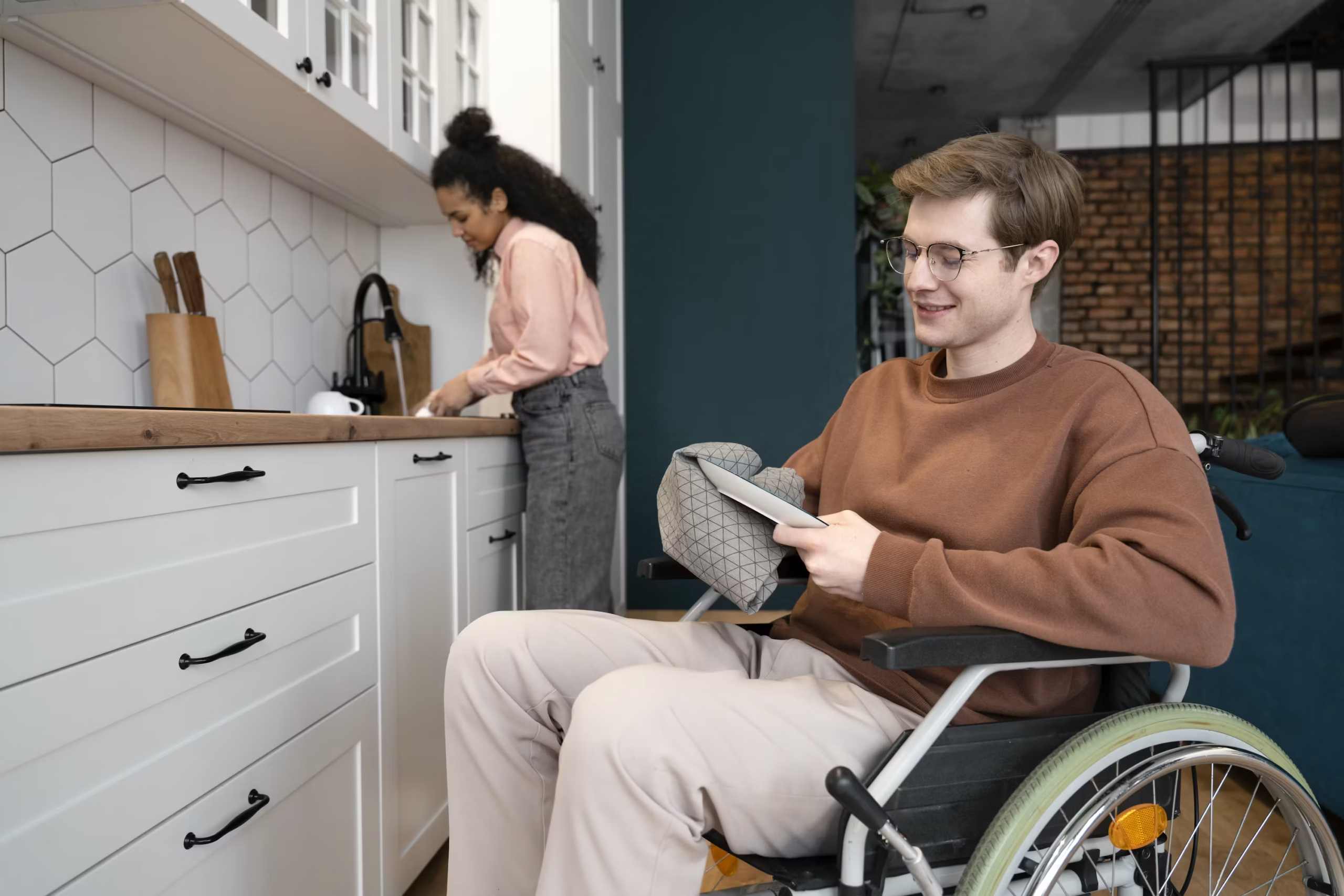
Imagine living in a house that is your own. The kettle is boiling, a familiar face asks about your sleep, and the plans will be yours for the day. Supported independent living helps thousands of Australians with disability to achieve that picture. You may have heard of Supported Independent Living (SIL) during an NDIS planning meeting and wondered, “What is Supported Independent Living (SIL)?” Then this guide is for you.
This will include learning about the who, what, how and what’s different in 2026 for providers compared to housing funding. Jargon remains low, and practical detail remains high, and you can make a decision with confidence.
What is supported independent living (SIL)?
Supported independent living (SIL) is a term used for funding support workers to help a person with disability live in their own home in their own community, and is a category of NDIS funding. It is aimed at those with higher support needs who need assistance throughout the day – or most of the day. That support can include helping them with everyday activities, monitoring them, and developing skills to enable them to be as independent as possible and be part of the community.
The concept is that SIL is about people, not property. Some live in their own home with a small group of housemates, and others live in their own home with regular support available 24 hours a day. In either case, a provider oversees and provides a set of supports, which are designed to be a match for the family.
What SIL Pays For and What It Leaves Out: Support
Consider SIL to be an agile team operating within your home, designed around your activities not the other way around. Funds are available for assistance on the following aspects:
- Personal care, such as showering, dressing and toileting
- Cooking and cooking skills
- Medication and health routines.
- Housekeeping duties including cleaning, laundry and other household chores
- Overnight Support (Staff Sleeping on Site) and/or Staff Sleeping Overnight.
- Developing money and travel skills in everyday life situations
What SIL does not pay for is just as important. Does not cover the building itself or rent, groceries, utilities, internet or furniture/personal spending. Typically, most community activities, employment supports and day programs are covered in your plan through a different funding source. This knowledge goes a long way to avoid unwanted surprises.
Does This Support Fit You? Who Can Access SIL
Knowing what is meant by independent living (SIL) can be very different from knowing whether or not it applies to you. Not all people with an NDIS plan have SIL, and not everyone in shared accommodation has SIL. Evidence will be used to determine if it’s reasonable and necessary for each person, as decided by the National Disability Insurance Agency (NDIS). SIL is thought about for participants who require assistance throughout the day or for the majority of the day, and who require assistance with or supervision of daily activities in order to live in their own home as independently as possible.
Similarly, not all arrangements are SIL. Where someone requires a few hours of support per day or week, or selects and arranges their own support workers (including directing and rostering these workers), different support items apply. Individuals may be better served looking at alternative home and living arrangements, such as Individualised Living Options (ILO).
Evidence matters. The level of support is demonstrated through an occupational therapy assessment, functional capacity reports and your support coordinator’s input.
What is different for SIL in 2026?
SIL would be provided by both registered and unregistered providers until mid-2026, which reduced the level of accountability for providers. All that changed on 1 July 2026. All providers of SIL services are now required to be registered with the NDIS Quality and Safeguards Commission with a new registration group called 0138 – Assistance with Supported Independent Living.
Registered providers will need to complete certification audits and be compliant with the core NDIS Practice standards as well as an additional module developed by SIL. The worker resources for the Commission is about decisions, feeling safe, getting good support and having a say about your home. Claiming has also changed, with new support items for claiming from 1 July 2026, including on provider invoices, and an updated NDIS operational guideline on supporting the implementation of the SIL that picks up the changes from 1 October 2026.
For participants, the upshot is simple. There is now a benchmark to compare providers with, and a question to ask before you sign a thing. Having an understanding of what supported independent living (SIL) is and how it is regulated, let’s now look at how it feels in real life.
What does good support look like? A Day in the Life: What Good Support Actually Looks Like
Now let’s assume that there is a fictional family of three people living together. Mornings are run at their own speed, with one person showering and taking their medication with the support of a member of the support team, and the other person making breakfast with gentle cues. One of the housemates goes to work, the other goes to a community class. In the afternoon, the children plan the shop for the week and cook their own lunch; staff only intervene when necessary. In the evening, it is time for movies, a call to your family or simply a quiet hour, and overnight staff is available if necessary.
The best SIL is like a home first, and a service second. The people living there don’t need help, but support workers can help them. People who live in the house make their own choices about what they eat, what they visit and how they spend their weekends.
How SIL Funding Works Behind the Scenes
SIL is part of an NDIS plan’s Core Supports budget. A provider can draw up a quote from a Roster of Care, a schedule indicating the required staffing levels and when support is needed each week. The NDIS then considers that information and makes decisions about funding.
Participants will typically contribute their own share of day-to-day expenses (including rent, groceries, utilities, etc.) and may use income support, e.g. Disability Support Pension, and/or Commonwealth Rent Assistance, if eligible. Typically, a tenancy/occupancy agreement for the home and a separate service agreement for the support will be signed, with the intention of allowing you greater flexibility should you wish to change either agreement at any time in the future. Request all charges to be in writing before signing.
Selecting a provider that is trustworthy: 7 questions to ask
The right provider will embrace your queries. Try these:
- Are you registered with the NDIS as part of group 0138? Can I do a quick check and look this up on the provider register on the NDIS Commission?
- Do I have an opportunity to meet my possible roommates before I make a commitment?
- How to match support workers, and how to maintain consistency of teams?
- Who sets house rules, shared spaces and visitors?
- If I want to switch to a different provider or if I move, what will happen?
- What is the process for dealing with complaints and incidents?
- Is there a written explanation of all the living expenses?
A simple roadmap from First Chat to Moving Day
1. Raise it early. Discuss your home and living aspirations with your support coordinator, Local Area Coordinator or NDIS planner, preferably at the time of your plan review.
2. Gather evidence. Gather evaluations and reports that demonstrate your needs on a day-to-day basis.
3. Explore your options. Go to the homes, connect with the providers and ask the questions listed above.
4. Request a quote. The provider you select prepares a quote for the NDIS to consider for your SIL.
5. Be patient and wait for the decision. You may request a review if you are not satisfied with it.
6. Transition gently. Before the permanent move, visit or stay for a night or two before deciding to move in, then check in periodically to monitor progress.
FAQ’s
What is supported independent living (SIL) in the NDIS?
Supported independent living (SIL) is NDIS funding for a package of home and living support for individuals with greater support needs. It covers the cost of support workers to help or oversee day-to-day tasks, enabling a person to live as independently as possible. It does not pay rent, groceries or rent the building.
Who can receive SIL funding?
There is no automatic eligibility. If the NDIS deems it reasonable and necessary, based on evidence, they might consider a SIL if they require assistance at all times of the day or most of the day. SIL is typically not provided to people who require limited hours of support, or who have their own support workers.
What does SIL pay?
Support given in the home, such as personal care, cooking, medication support, housework, skill development, and overnight support, is covered by SIL. Does not include rent, food, utilities, or personal expenses. Most community activities and day programs will typically be covered as separate funding sources within the plan.
What is the difference between SIL and SDA?
Support workers may be paid from SIL for work you do at home, and Specialist Disability Accommodation (SDA) is a funding type for specially designed housing for people with very high support needs or extreme functional impairment. You can have SIL, SDA or both. They are two different funding streams and have different purposes.
Who is responsible for the rent and food in a SIL home?
The participant typically contributes a portion of their earnings, including Disability Support Pension, to their rent, groceries and utilities, and if they are eligible, receive Commonwealth Rent Assistance. Support is not covered by these day-to-day living expenses, which are paid out of NDIS SIL funding.
Do SIL providers have to be registered?
Yes. As of 1 July, 2026, a provider providing SIL services will need to be registered with the NDIS Quality and Safeguards Commission as a provider in registration group 0138. They need to undergo certification audits and comply with the NDIS Practice Standards, including a new module for SIL.
What do I need to do to have SIL included in my NDIS plan?
As a first step, talk with your support coordinator or NDIS planner about your goals for home and living, and obtain assessments of your day-to-day support needs. The NDIS will determine if it will fund a SIL quote prepared by a provider of a service. You may request a review if you do not agree with the decision.
The support fits you; your home is where you’re at.
At the core of supported independent living (SIL) is what? It is a place for Australians with higher support needs to live a place where they have a place they call home alongside skilled people and not under them. It doesn’t fund the structure, and providers are now subject to stricter standards as a result of the changes to the registration in 2026.
When considering SIL for yourself or a family member, begin with the goals, collect evidence and ask questions. There will be no pressure, and our team would be happy to walk you through the options in plain English. Contact us today to begin the discussion of a home that’s right for you.